Loading…
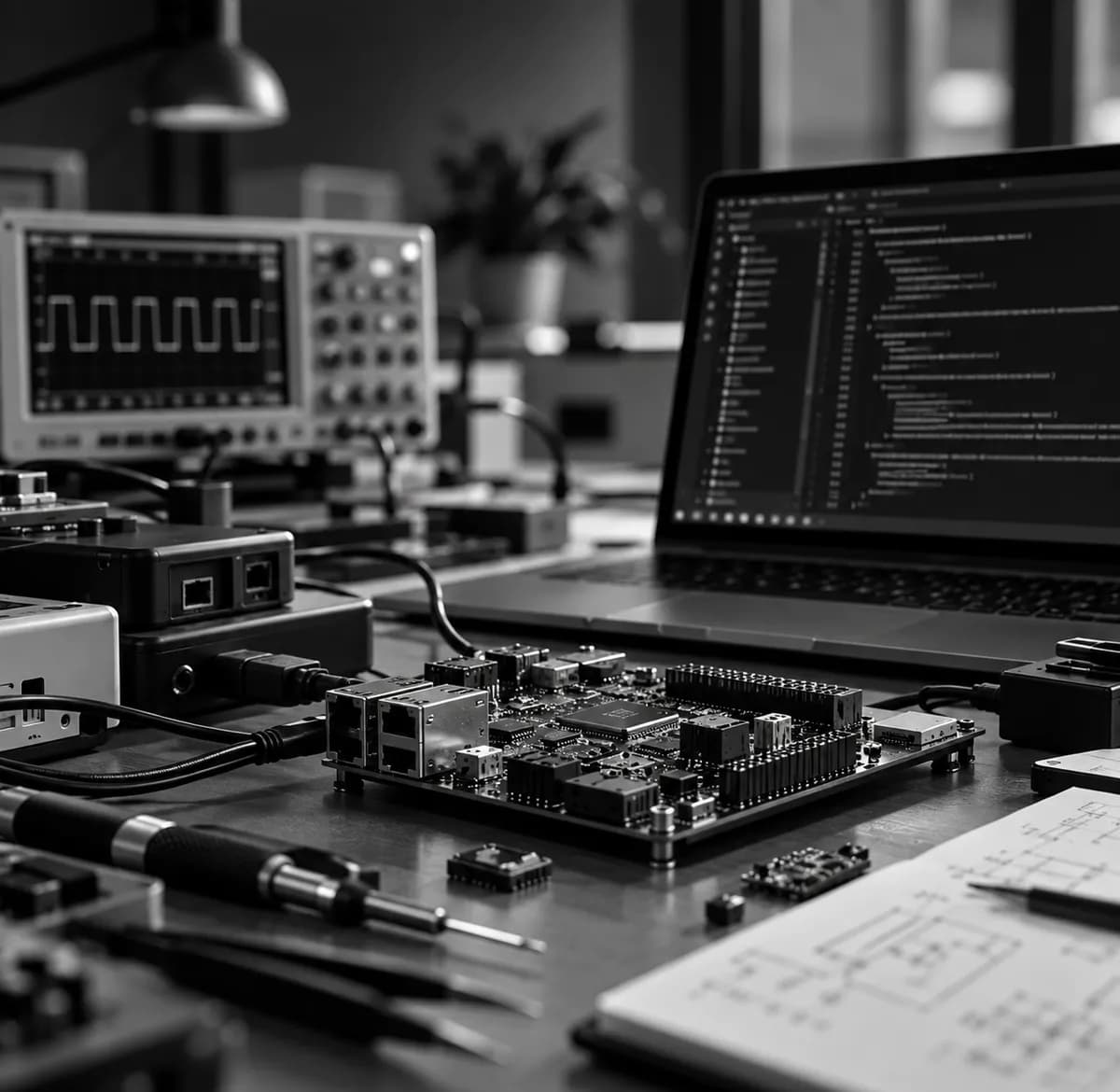
Embedded systems development.
We design and build embedded systems end to end — firmware, electronics, and production handover — for connected devices, industrial equipment, and smart building products, on microcontrollers, Embedded Linux, and SoM platforms.
What we build.
PettersonApps handles embedded development from prototype to production, including schematic and PCB design, firmware, drivers, connectivity, and validation. One team manages both hardware and software, ensuring they work together seamlessly.
Firmware for microcontrollers
ESP32 (S2, S3, C3, C6), ESP8266, and STM32 (L0, L4, F1, F4, F7, H7)
Embedded Linux products
Buildroot, Yocto, Device Tree, and BSP bring-up on Raspberry Pi CM4/CM5, NVIDIA Jetson, and Lantronix Open-Q
RTOS-based systems
FreeRTOS, Zephyr, and Azure RTOS (ThreadX) with multithreaded, memory-safe architecture
Wireless products
BLE, Wi-Fi, Matter, Thread, Zigbee, and LoRaWAN, including provisioning and mesh networking
Industrial and building automation
Modbus, CAN and CAN FD, J1939, KNX, DALI-2, M-Bus, 0-10 V, and 4-20 mA, including protocol gateways
Camera and display products
Sony IMX sensors over MIPI CSI-2, USB 2.0/3.x, LVDS, and HMI on LVGL, OLED, E-Ink, and touchscreens
Motor control and sensing
DC, BLDC, and stepper drives with closed-loop control, IMU and analog acquisition
Custom hardware
Multilayer PCB and flex cable design in Altium Designer and KiCad, power architecture, and board bring-up
Secure connected devices
Secure Boot, flash encryption, TLS with mbedTLS or wolfSSL, and secure OTA updates with anti-rollback
Production readiness
BOM management, second-sourcing, obsolescence planning, and coordination with contract manufacturers
Inside the device.
Every part on this board is something we design, write, or bring up ourselves. Point at one to see the layer behind it.
04.Connectivity
Wireless
Provisioning, mesh networking, and secure device-to-cloud links — tuned on the bench until the radio meets its range and power budget.
- BLE
- Wi-Fi
- Matter
- Thread
- Zigbee
- LoRaWAN
Who we work with.
Hardware startups building a first product
You have a product concept and need a team that covers both the board and the code. We take you from architecture and component selection to a validated prototype and a design ready for small-batch production, and we tell you early when a cheaper chip or simpler design meets the requirement.
Companies needing firmware or a device redesign
Your current device is unstable, hard to update, or built around an obsolete component. We review the existing design, stabilize or rewrite the firmware, add secure OTA updates, and handle second-sourcing so supply problems stop driving your roadmap.
Industrial and building automation manufacturers
Your equipment must talk to PLCs, meters, lighting, and building systems. We implement Modbus, CAN, KNX, DALI, and M-Bus on your hardware, and build gateways that convert between protocols and connect the field level to the cloud.
Product teams with apps but no device team
You already have an app or platform and need the connected hardware to match. We build firmware, wireless provisioning, and secure device-to-cloud communication so the device works with your backend from the first release. Cloud and app work is covered by our IoT development team.
Silicon to cloud.
In most connected products, every layer is a handoff to another vendor. With us it is one team, from silicon to cloud, so a problem is traced through the whole stack instead of bounced between vendors.
One stack, one team.
Device-to-cloud messaging and the APIs your backend and apps talk to, developed together with the firmware so data arrives in the shape the product expects.
- MQTT
- AWS IoT
- REST
Secure Boot, flash encryption, and TLS from the first build, plus signed OTA updates with anti-rollback so every device in the field can be updated safely.
- Secure Boot
- TLS
- OTA
Provisioning, mesh networking, and radio tuning on the bench until each link meets its range and power budget.
- BLE
- Wi-Fi
- Matter
- LoRaWAN
Bare metal, RTOS, or Embedded Linux chosen to fit the product, with Yocto and BSP bring-up handled by the team that writes the drivers.
- FreeRTOS
- Zephyr
- Yocto
C and C++ on ESP32 and STM32, written by the same engineers who laid out the board, so a timing bug is chased from the register to the cloud without a handoff.
- ESP32
- STM32
- C/C++
- Unit tests (Unity)
Component selection, multilayer PCB and flex design, and board bring-up on the bench before the first production run.
- Altium
- KiCad
- bring-up
How we work.
One team, one build.
01.Architecture first
Most embedded projects go over budget because of early choices: the wrong MCU, too little memory, or a power budget that misses battery-life targets. We start by fixing requirements, interfaces, power and cost targets, and pick the platform and components with second-sourcing and lifecycle in mind.
02.Developed together
The same engineers who design the PCB write and debug the firmware, so problems are traced across the boundary. We bring up every board with oscilloscopes and logic analyzers, test signal integrity and protocols, and validate the design with unit tests and hardware-in-the-loop (HIL) testing.
03.Built for production
A working prototype is not a product. We build with Git, CMake, and CI/CD pipelines (GitHub Actions, GitLab CI), document the code with Doxygen, implement secure OTA updates, and support the move to manufacturing: BOM, component sourcing, and coordination with the contract manufacturer.
Technology we use.
- Microcontrollers
- ESP32 (S2, S3, C3, C6)
- ESP8266
- STM32 (L0, L4, F1, F4, F7, H7)
- Processors & SoMs
- Raspberry Pi
- CM4
- CM5
- NVIDIA Jetson
- Lantronix Open-Q
- Operating systems
- FreeRTOS
- Zephyr
- Azure RTOS (ThreadX)
- Buildroot
- Yocto
- Device Tree
- Imaging
- Sony IMX sensors
- MIPI CSI-2
- High-Speed & Display
- USB 2.0
- USB 3.x SuperSpeed
- CDC / HID / MSC
- LVDS
- SDIO
- Ethernet (LwIP)
- Low-speed interfaces
- I²C
- SPI
- QSPI / OSPI
- UART / USART
- 1-Wire
- Wiegand
- Automation Protocols
- Modbus RTU / TCP / ASCII
- M-Bus
- CAN 2.0A/B
- CAN FD
- J1939
- KNX TP/IP
- DALI / DALI-2
- Wireless & IoT
- Matter (Wi-Fi / Thread)
- Zigbee
- Thread
- LoRaWAN
- BLE GATT
- BLE Mesh
- BLE Advertising
- Cloud & connectivity
- MQTT (Mosquitto, AWS IoT)
- WebSockets
- REST API
- CoAP
- JSON
- Protobuf
- CBOR
- Motion control
- DC motors
- BLDC motors
- Stepper motors
- Motor driver ICs
- Sensors & analog
- IMUs
- PWM (motor / LED)
- Accelerometers (TDK ICM-42670-P)
- ADC / DAC with oversampling
- Power management
- Buck
- Boost
- Buck-boost
- LDOs
- Li-ion chargers
- Power supervisors
- HMI & displays
- LVGL
- I²C / SPI LCDs
- OLED
- E-Ink
- Touchscreens
- PCB design
- Altium Designer
- KiCad
- Multilayer PCBs
- Custom FPC / flex cables
- Hardware validation
- PCBA bring-up
- Signal integrity
- Multimeters
- Protocol analysis
- Oscilloscopes
- Security & storage
- Secure Boot
- Flash encryption
- TrustZone
- Hardware crypto
- LittleFS
- SPIFFS
- FatFS
- DevOps & quality
- Git (GitFlow)
- CMake
- Ninja
- PlatformIO
- GitHub Actions
- GitLab CI
- Supply chain & production
- Component sourcing
- BOM management
- Production management
FAQ.
Before you ask.
Embedded development is the design of the firmware and electronics that run inside a physical product, such as a sensor, controller, or smart appliance. PettersonApps covers the full chain: architecture, schematic and PCB design, firmware, wireless and cloud connectivity, validation, and production support, so one team is responsible for the working device.
Yes. We design multilayer PCBs and flex cables in Altium Designer and KiCad, including power architecture, high-speed routing, and DFM/DFA review, and we bring up the boards ourselves. The same engineers write the firmware, which removes handoff gaps. If you already have a board, we can work on firmware only.
We build firmware for Espressif ESP32 and ESP8266 and STMicroelectronics STM32 microcontrollers, and Embedded Linux products on Raspberry Pi CM4/CM5, NVIDIA Jetson, and Lantronix Open-Q modules. We use FreeRTOS, Zephyr, Azure RTOS (ThreadX), Buildroot, and Yocto. We choose the platform by requirements, cost, and supply risk.
We implement wireless standards (BLE, Wi-Fi, Matter, Thread, Zigbee, LoRaWAN), industrial buses (Modbus, CAN, CAN FD, J1939), and building automation protocols (KNX, DALI-2, M-Bus, 0-10 V, 4-20 mA). We also build protocol gateways and connect devices to the cloud over MQTT, CoAP, WebSockets, or REST with TLS.
We use Secure Boot, flash encryption, and hardware crypto such as TrustZone where the chip supports it, and protect device-to-cloud traffic with TLS (mbedTLS or wolfSSL) and X.509 certificates. Firmware updates are delivered over the air with signature checks and anti-rollback protection, so a device only accepts trusted, newer firmware.
Timelines depend on scope: a firmware-only project on an existing board is typically shorter than a new device with custom PCB, validation, and certification prep. We support production through BOM management, component sourcing, second-sourcing, and coordination with your contract manufacturer.
Start with clarity.
Planning a new device or fixing one?
Share your requirements or current design. We review the architecture, components, and risks, then provide a written technical assessment with a recommended approach and scope estimate.